
Published October 10, 2026
What Mat-Su contracts are telling me about this fall

If you've been reading market updates lately, most of them say the same thing: sales are holding up and prices are only down a little. I get why. Palmer and Wasilla closed 168 homes in June and 150 in September, which doesn't look like much of a change. The catch is that a closed sale is the last step of a deal that started a month or two earlier. Closed sales tell you where the market was. If you want to know where it's going, you have to look at contracts.
I've been doing this for 15 years and I've been part of thousands of deals in the Valley. The numbers I trust most when the market turns are new pendings, cancellations, and how close homes sell to their original list price. Right now all of them are moving the same direction.
What the contracts are saying
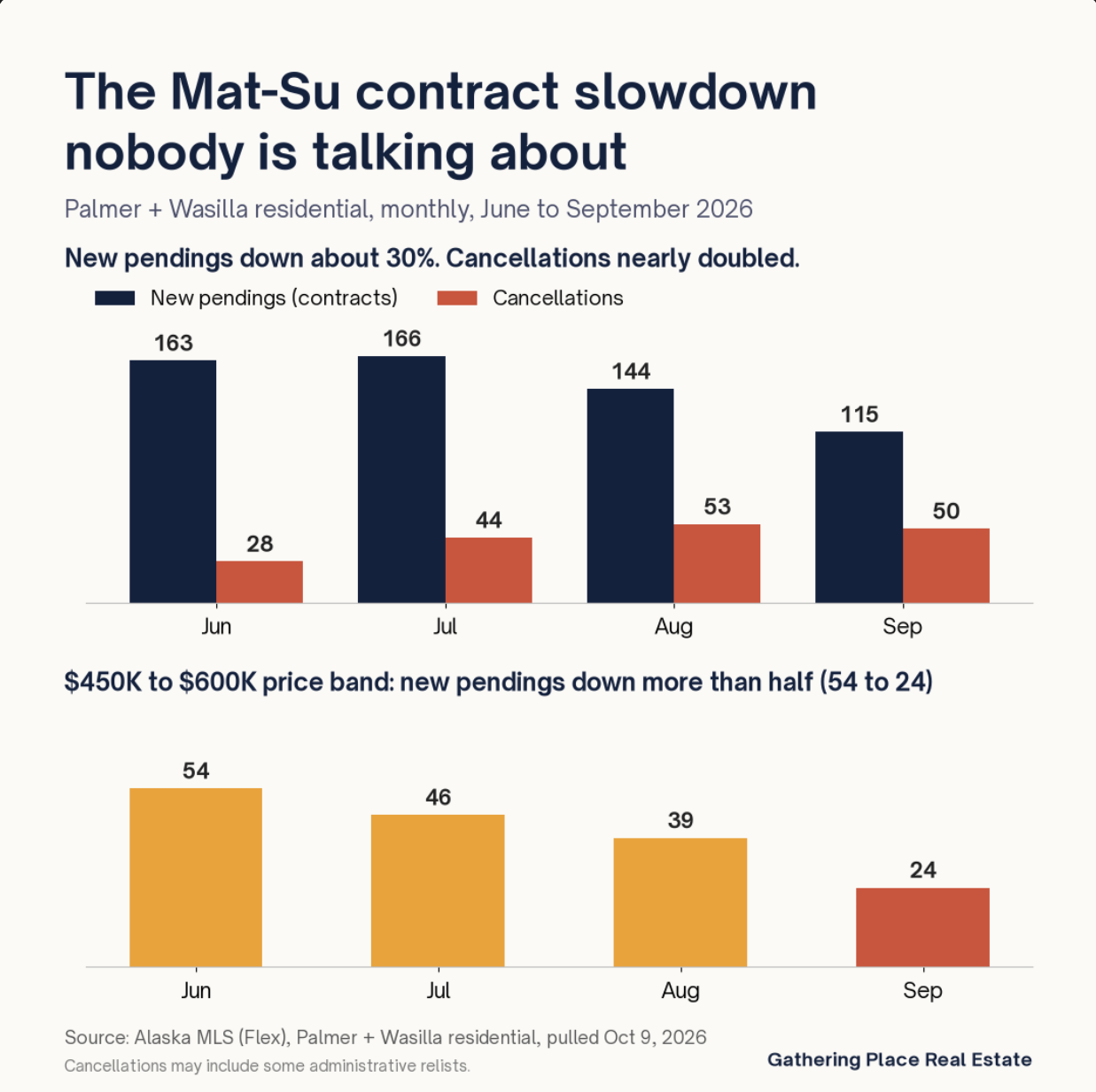
New pendings in Palmer and Wasilla went from 163 in June and 166 in July down to 144 in August and 115 in September. That's roughly 30% fewer homes going under contract than in early summer, while active inventory stayed pretty flat at around 400 to 430 listings all season. Sellers didn't disappear. Buyers pulled back.
The pullback isn't even across price points. Under $450K, pendings went from the 81 to 87 range in June and July to 72 in August and September, roughly 15% lower. Between $450K and $600K they went from 54 in June to 24 in September, down more than half. That middle band is where higher rates bite the hardest, because those are the move up buyers who are most payment sensitive.
Cancellations nearly doubled, from 28 in June to 50 in September (some of those are likely administrative relists, so I wouldn't read every one as a seller giving up). In June we had about six new contracts for every cancellation. In September it was a little over two.
Borough wide, the softening shows up in the details too. Median days on market went from 8 in June to 18 in September. Homes sold for 99% of original list price in June and July, then 96.9% in August and 97.8% in September. The median sale price slipped from $448,000 in June and July to $425,000 in August and September, and months of inventory crept from about 3.0 to about 3.5. That's a softer market, and it's still a long way from a glut.
What the lenders are seeing
Mortgage applications are a leading indicator too, and they've been going the wrong way. Freddie Mac's 30 year fixed average hit 7.40% on October 8, up from 6.30% a year ago. That was the seventh straight weekly increase and the highest rate since November 2023.
The Mortgage Bankers Association's weekly survey shows what that's doing to demand. Their seasonally adjusted purchase index slipped every week in September and kept falling into October, and for the week ending October 2 purchase applications were 15% below the same week last year. Refinance applications were 56% below last year, and refis dropped to 37% of all applications from almost 41% at the start of September. More borrowers are reaching for adjustable rate loans to get the payment down. ARMs made up 10.3% of applications in late September and early October, the highest share since October 2025.
Nationally it's the same picture. Zillow reported newly pending sales in September down 8.5% from a year ago and 11.2% from August, with 27.4% of listings taking a price cut. NAHB says 38% of builders cut prices in September, by an average of 6%, and 66% were using incentives.
My predictions (labeled as predictions)
These are my calls based on the data above and what I'm seeing in the field every day. I could be wrong, and I'll tell you if I am.
I expect Palmer and Wasilla closings to fall this fall, probably into the 110 to 135 a month range for October and November, because the contracts that will close in those months were written during the slowdown. I expect prices to drift flat to modestly lower through winter rather than fall off a cliff. My gut says the $450K to $600K band is where the most negotiating happens, and under $450K stays steadier because entry level buyers are still out there. If rates back off even half a point, I think a lot of those sidelined buyers come back quickly.
One early signal I'm watching: October 1 through 8 brought 35 new pendings, a pace of about 135 for the month, which is a little better than September. Eight days isn't enough to call a bottom. It's worth keeping an eye on.
Buyers
This is the best negotiating position buyers have had in the Valley in years, even with rates where they are. Homes are sitting longer, more sellers are open to concessions, and you can ask for closing cost help or a rate buydown without getting laughed out of the room. Builders are offering incentives too. In full disclosure, I'm the sales and marketing partner for Hall Quality Homes, so I'm biased on new construction, but it's worth knowing that new builds made up about 18% of Palmer and Wasilla closings in August and September and builders nationally are leaning hard on incentives. Run the numbers on both.
Sellers
Take a breath. The pandemic pulled years of appreciation forward, and what we're seeing now is the market settling back toward a normal pace, which I'd put at about 5% a year. The state's numbers make the point. The Alaska Department of Labor and AHFC had the average Mat-Su single family sale at $311,686 in early 2020. At a normal 5% a year, that would have been about $361,000 by early 2023. The actual number was $455,414, roughly 26% ahead of that pace. By the end of 2024 the average was $445,351, still about 13% above the trend line. If you bought a $390,000 home in February 2020, normal 5% a year appreciation alone would put it around $540,000 today, and most of your gains showed up early. A softer market doesn't erase that. What it does mean is that pricing matters more than it did last spring. If you price it right on day one, you'll sell. Chasing the market down with reductions is how you end up with a stale listing and a lower number.
Agents and lenders
Turn times are getting longer and deals need more care to get to the closing table. With cancellations up, I'm planning around more renegotiation and more files that need a backup buyer, and I'd encourage every agent and loan officer I work with to do the same. Organize your pipeline around longer timelines and get sharp on buydowns and ARMs, because clients need someone who actually understands the financing options right now. The people who add real value in a slower market are the ones still standing when it picks back up.
Bottom line
The closed numbers are going to catch up to what the contracts are already saying. I'm not worried. This is a market getting back to normal, and normal is a perfectly good market to make a move in.
If you want to talk through what this means for your own move or your business, just hit reply or give me a call.
Sources: Alaska MLS (Flex), Palmer + Wasilla residential, pulled October 9, 2026; Flex Market Trends for Mat-Su Borough; Freddie Mac PMMS; Mortgage Bankers Association Weekly Applications Survey; Zillow; NAHB; Alaska Department of Labor and AHFC Alaska Housing Market Indicators. Predictions are my own opinion and not a guarantee of future results.
or another way